What Makes Good Money, A Summer’s Evidence
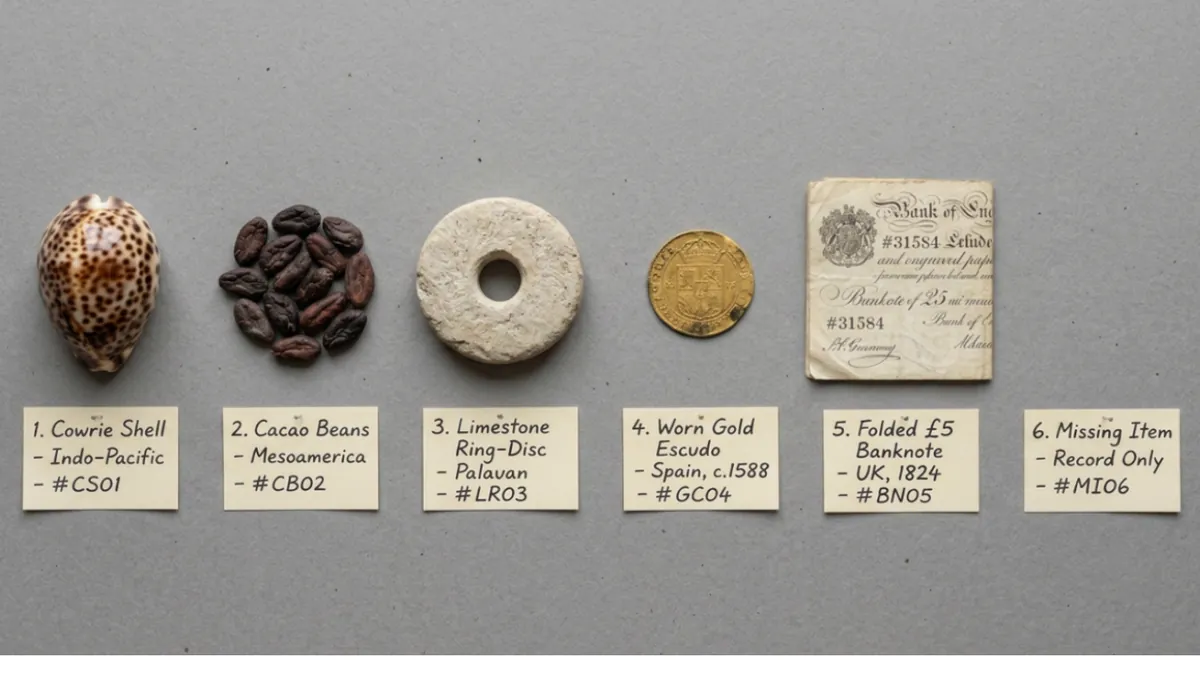
All summer this project has told stories: cowrie shells counted out in African and Asian markets, stone wheels resting against Pacific houses, salt paid to Roman soldiers, pepper ransoming a city, a Florentine coin that kept its weight for two and a half centuries, and gold anchoring the trade of the world for forty years that felt like forever. It is time to put the stories on one table and ask what they were all about.
The question they answer is old and practical: what makes good money? Not what makes money official, which is a legal question, and not what makes money valuable in a given year, which is a market question, but what properties allow a thing to do money’s work across generations. In 1892 the economist Carl Menger insisted that the answer could not be found in statutes, and his framing is worth reading in his own words:
It is not impossible for media of exchange, serving as they do the commonweal in the most emphatic sense of the word, to be instituted also by way of legislation, like other social institutions. But this is neither the only, nor the primary mode in which money has taken its origin. (Menger 250)
Money, in Menger’s account, is discovered rather than decreed. Traders converge on the most saleable good available, the one everyone accepts because everyone else will, and history is the record of that convergence. The summer’s case studies are that record, and running them through the properties of sound money turns a pile of stories into a body of evidence.
Scarcity first, because it fails most dramatically. Cowries worked as money for centuries where they were genuinely hard to obtain, and collapsed wherever ships learned to deliver them by the ton, drowning the money in its own supply. Pepper tells the same story at higher stakes. Pliny watched a hundred million sesterces a year flow east for it when the routes were few (Pliny 12.41), and the Age of Sail unmade its value within generations by multiplying the routes. Any money whose supply can be cheaply expanded will be, and the expansion is paid for by everyone holding the old units.
Durability: salt paid Roman soldiers and gave us the word salary, but it dissolves in the rain, and wealth that cannot survive a storm cannot store a lifetime’s work. Gold survived shipwreck and century alike, which is much of why it outlasted its rivals.
Divisibility and portability, the practical twins. The great fei of Yap were magnificent and unsplittable, which is why small daily exchange on the island ran on humbler media while the stones settled great matters. The florin crossed Europe in a purse. The rai stone could not cross the room. A money must scale down to a day’s wage and travel to wherever the trade is, and each historical money found its limit on one axis or the other.
Verifiability may be the most underrated property of all, and the summer gave us its clearest champion. The florin’s genius was not merely that Florence refrained from debasing it for two and a half centuries, but that any merchant anywhere could check the claim himself with a scale. Compare the goldsmith’s receipt, whose worth depended on one man’s honesty rather than anyone’s scale, and which accordingly required the elaborate machinery of trust that London spent two centuries building. A money whose rules anyone can check, and no one can quietly change, has always outcompeted money that depends on trusting the issuer’s restraint.
Which brings us to the property that does not appear on the physical list. Furness saw on Yap that a money is at bottom a shared record, valid, as he put it, even for a stone lying at the bottom of the sea, “as if it were leaning visibly against the side of the owner’s house” (Furness 97). Every money is an agreement, and agreements have a human property: the discipline of the people keeping them. Gold scored well on nearly every physical test and still failed in 1933 and 1971, not as a metal but as a promise, because the institutions promising redemption chose exceptions over rules. The florin kept its rule for centuries. The Medici bank bent its rules for princes and died in ninety-seven years. The pattern is the same at every scale.
No money in the summer’s evidence scored perfectly, and that is the finding. Each was the best available agreement of its time and place, and each failed along the property it lacked, usually the moment technology or trade exposed the lack. That is why we teach the properties not as a checklist but as a set of questions to interrogate any money, past or present, including the money in the reader’s pocket and the newer forms now being argued about. What is its supply rule, and who can change it? What does it cost to verify, to move, to divide, to store? And when its stewards face a choice between keeping the rule and making an exception, what does history suggest they will do? Students who can ask those questions of a cowrie shell can ask them of anything. The theme week this essay opens will spend September doing exactly that.
The Money Wisdom Project is a Texas 501(c)(3) nonprofit. All of our K-12 monetary history curriculum is free under a CC BY 4.0 license at moneywisdomproject.org.
Works Cited
Furness, William Henry, III. The Island of Stone Money: Uap of the Carolines. J. B. Lippincott, 1910.
Menger, Carl. “On the Origin of Money.” Translated by Caroline A. Foley, The Economic Journal, vol. 2, no. 6, 1892, pp. 239-255.
Pliny the Elder. The Natural History. Translated by John Bostock and H. T. Riley, Taylor and Francis, 1855.

Educator, curriculum designer, and founder of the Money Wisdom Project.