Pepper as Money, The Spice Trade from Rome to the Age of Sail
In the year 408, the Visigoth king Alaric camped his army outside the walls of Rome and named the price of the city’s survival. The historian Zosimus, our fullest source for the negotiation, records terms that should stop a modern reader mid-sentence: five thousand pounds of gold, thirty thousand pounds of silver, four thousand silk tunics, three thousand hides dyed scarlet, and three thousand pounds of pepper (Zosimus 5.41). Edward Gibbon, retelling the scene from the ancient sources, preserved the negotiation’s most chilling exchange. When the Roman envoys hinted at the desperate resistance of a numerous people, Alaric answered, “The thicker the hay, the easier it is mowed,” and when they asked what he would leave them if they paid, the reply was two words: “Your lives” (Gibbon ch. 31).
Gold and silver need no explanation in a ransom. But when a conqueror demands a spice by weight alongside precious metal, that spice is no longer a seasoning. It is functioning as money, and everyone at the table knew it.
Rome had known it for centuries, and worried about it. Pliny the Elder, writing in the first century, was the empire’s great accountant of luxury, and the eastern trade offended him twice over: once as economics and once as morals. On the economics, he ran the numbers:
And by the lowest reckoning, India, the Seres, and that Peninsula, withdraw from our Empire one hundred millions of sesterces every year: so dearly do we pay for our luxury and our women. (Pliny 12.41)
His grievance reads remarkably like a modern editorial about trade deficits, and the anxiety has not aged in two thousand years. On the morals, Pliny simply could not fathom the object of the trade itself:
It is quite surprising that the use of pepper has come so much into fashion, seeing that, in other substances which we use, it is sometimes their sweetness, and sometimes their appearance that has attracted our notice; whereas, pepper has nothing in it that can plead as a recommendation to either fruit or berry, its only desirable quality being a certain pungency; and yet it is for this that we import it all the way from India. (Pliny 12.14)
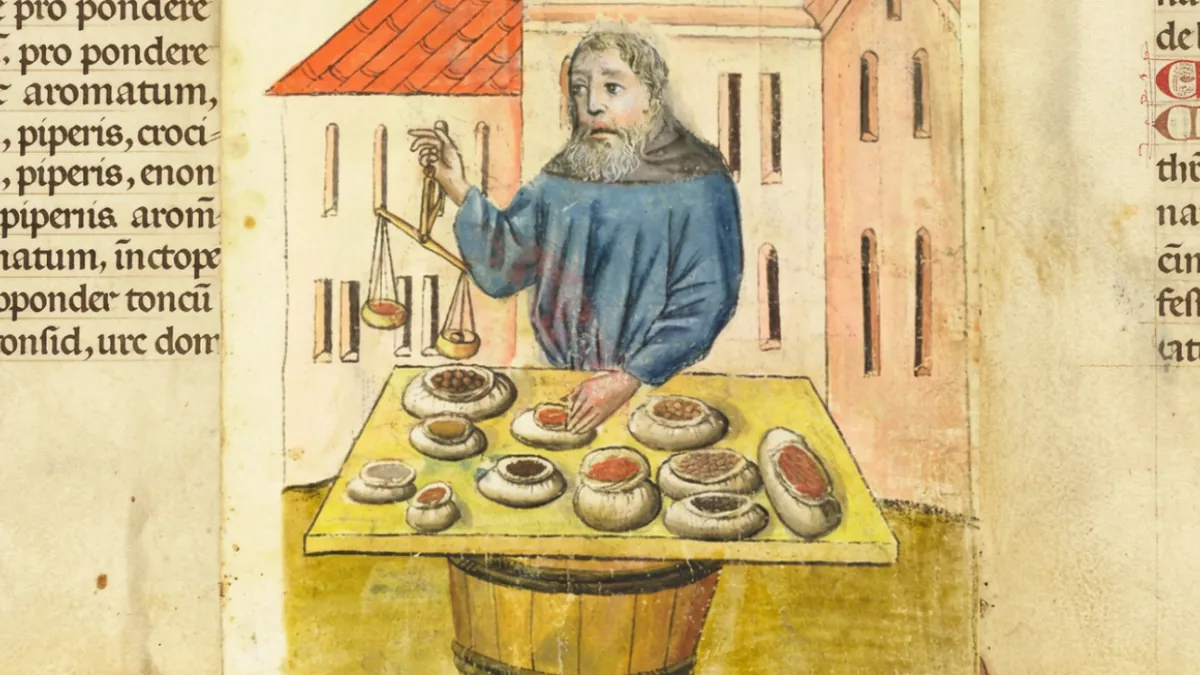
Notice what the moralist misses and the market understands. The “certain pungency” was almost beside the point. Pepper had the properties that money requires. It was durable enough to cross an ocean in a ship’s hold. It was divisible down to a single corn. It was portable, with high value packed into little weight. And it was recognized and wanted in every port from Alexandria to the Malabar coast. Universal desire plus constrained supply is the recipe from which monies are made, and Pliny’s hundred million sesterces were not being squandered on flavor. They were buying the era’s most saleable good.
The scale of the trade at its medieval height comes to us from Marco Polo, who saw its eastern terminus with his own eyes. Standing in the Chinese port of Zaiton in the late thirteenth century, he reached for a comparison his European readers could grasp:
And I assure you that for one shipload of pepper that goes to Alexandria or elsewhere, destined for Christendom, there come a hundred such, aye and more too, to this haven of Zayton; for it is one of the two greatest havens in the world for commerce. (Polo bk. 2, ch. 82)
Europe, sitting at the far thin end of that funnel, priced pepper accordingly. Rents were paid in it, dowries counted in it, and accounts settled in it. The phrase peppercorn rent survives in English law today, meaning a token payment, precisely because the payment was once anything but token. Language keeps receipts long after the money itself is gone.
The system held for a thousand years, and then it ended, not with a collapse but with a route. In May 1498 Vasco da Gama anchored off Calicut after ten months at sea, having rounded Africa entirely. The anonymous journal of the voyage, the Roteiro, records the first exchange ashore. A crew member sent into the city was confronted by two Tunisian merchants, astonished to hear Iberian speech so far from home, who demanded to know what had brought the Portuguese to India. The answer has become the epitaph of an entire economic era: “We come in search of Christians and of spices” (Roteiro 60).
The sea route did what no army had done: it broke the chokepoints. For centuries pepper had passed through a relay of middlemen, each adding a margin, from Malabar through the Red Sea or Persian Gulf, overland to the Mediterranean, and through Venice to Europe. A ship that sailed from Lisbon to India and back replaced the entire relay. Supply grew, routes multiplied, prices fell, and within a few generations pepper was on its way to becoming what it is now, a pantry item.
The spice trade teaches the lesson that opens every serious study of money. Value is not decreed and it is not intrinsic. It emerges from scarcity, usefulness, and the agreement of many strangers, and it can drain away when any of those conditions change. Pepper was money while it was scarce and wanted. When the ships multiplied, the world quietly repriced it, and only the historians noticed the funeral.
The Money Wisdom Project is a Texas 501(c)(3) nonprofit. All of our K-12 monetary history curriculum is free under a CC BY 4.0 license at moneywisdomproject.org.
Works Cited
Gibbon, Edward. The History of the Decline and Fall of the Roman Empire. Vol. 3, Strahan and Cadell, 1781.
Pliny the Elder. The Natural History. Translated by John Bostock and H. T. Riley, Taylor and Francis, 1855.
Polo, Marco. The Book of Ser Marco Polo. Translated and edited by Henry Yule, John Murray, 1871.
A Journal of the First Voyage of Vasco da Gama, 1497-1499. Translated and edited by E. G. Ravenstein, Hakluyt Society, 1898.
Zosimus. New History. Translated by Ronald T. Ridley, Australian Association for Byzantine Studies, 1982.

Educator, curriculum designer, and founder of the Money Wisdom Project.